Blog Articles

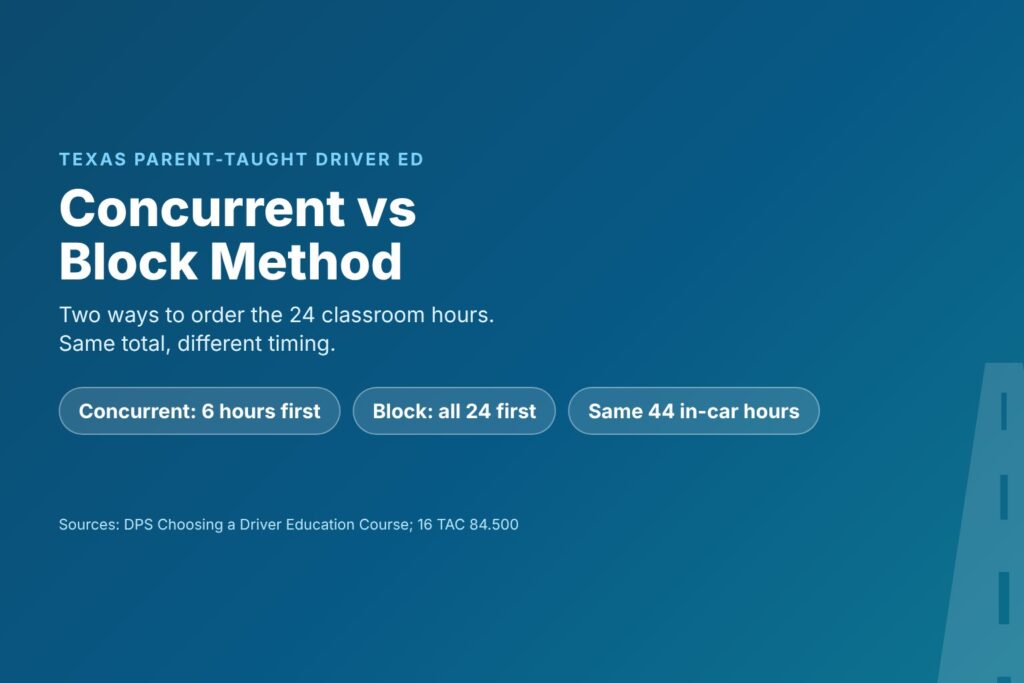
Title card reading Concurrent vs Block Method, two ways to order the 24 classroom hours in Texas PTDE

Texas PTDE: Concurrent vs Block Method — Which Should Your Family Choose?

Updated October 2026 · Reviewed by Billy Forte The Texas PTDE concurrent method lets a teen take the first 6 hours of classroom instruction, get a learner license, and then finish the other 18 hours while practicing driving. The block method finishes all 24 classroom hours before the learner license. Both methods lead to the same 44 in-car hours, the same DE-964 certificate and the same DPS steps. Key Facts Two Ways to Order the Classroom Hours Every Texas teen course has a classroom phase of at least 24 hours. 16 TAC 84.500 sets that minimum, which took effect December

Texas PTDE: Concurrent vs Block Method — Which Should Your Family Choose? Read More »
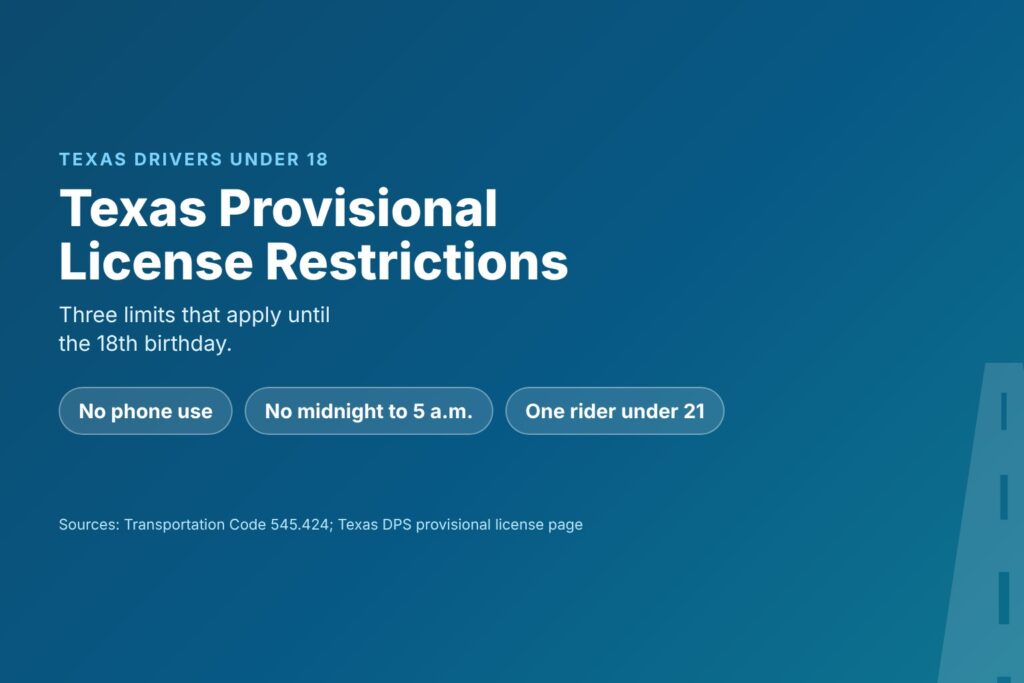
Title card reading Texas Provisional License Restrictions, with phone, late-night and passenger chips

Texas Provisional License Restrictions: Complete Rules for 16-Year-Old Drivers

Updated October 2026 · Reviewed by Billy Forte Texas provisional license restrictions are three limits for drivers under 18: no phone use while driving, no driving from midnight to 5 a.m. without a listed reason, and no more than one passenger under 21 who is not a family member. They come from Transportation Code 545.424 and appear on the DPS provisional license page. This guide puts all three in one place, with the fines, the enforcement rule and the end date. Key Facts Texas Provisional License Restrictions at a Glance Here are the three restrictions side by side. Each row

Texas Provisional License Restrictions: Complete Rules for 16-Year-Old Drivers Read More »

Title card reading Parent Taught Drivers Ed in Texas, with 24 classroom hours and 44 in-car hours

Parent Taught Drivers Ed Texas: The Complete PTDE Guide

Updated October 2026 · Reviewed by Billy Forte Parent taught drivers ed Texas (PTDE) lets an eligible parent or other approved adult teach a teen the state driver education course, using curriculum bought from a TDLR-licensed provider. The course has 24 classroom hours and 44 in-car hours, and the parent must first apply to TDLR to become the instructor. When the teen finishes, the provider issues the DE-964 certificate, and the license steps at DPS are the same as for a driving school student. Key Facts Parent Taught Drivers Ed Texas at a Glance PTDE is one of four driver

Parent Taught Drivers Ed Texas: The Complete PTDE Guide Read More »

Title card reading Texas Parent Taught Drivers Ed Cost, with the $20 TDLR fee and two $16 DPS fees

Texas Parent Taught Drivers Ed Cost: What to Expect

Updated October 2026 · Reviewed by Billy Forte The texas parent taught drivers ed cost is made of a few official fees plus the course price: a $20 TDLR instructor designation, a $16 DPS learner license, a $16 DPS under-18 driver license and the free Impact Texas Teen Drivers (ITTD) program. The course itself is bought from a TDLR-licensed provider, and each provider sets its own price. That means the official fees add up to $52 for one child, and the course price is the part you shop for. Key Facts The Official Texas Parent Taught Drivers Ed Cost Table

Texas Parent Taught Drivers Ed Cost: What to Expect Read More »

Title card comparing a Texas learner license with a provisional driver license for teens

Texas Learner’s Permit vs Driver’s License: What’s the Difference?

Updated October 2026 · Reviewed by Billy Forte Texas learners permit vs driver’s license comes down to supervision: a learner license holder drives only with a licensed adult 21 or older in the front passenger seat, while a provisional license lets a teen of 16 or 17 drive alone. The provisional license adds under-18 limits on late-night driving and passengers, and the phone ban covers both. Both licenses expire on the 18th birthday. Key Facts Two Licenses, Two Phases Texas licenses teens in two phases under the Graduated Driver License (GDL) program. The Texas Driver Handbook calls them Phase One

Texas Learner’s Permit vs Driver’s License: What’s the Difference? Read More »

Title card reading Texas Learners Permit Restrictions, adult 21 or older in front and no phone use

Texas Learner’s Permit Restrictions: What Your Teen Can and Can’t Do

Updated October 2026 · Reviewed by Billy Forte Texas learners permit restrictions come down to two rules on every drive: a licensed adult 21 or older rides in the front passenger seat, and the teen may not use a phone, even hands-free, except in an emergency. Breaking the phone rule carries a $25 to $99 fine under Texas law, or $100 to $200 with a prior conviction. The learner license must also be held at least six months and ends on the 18th birthday. Key Facts Rule 1: A Licensed Adult in the Front Seat The DPS learner license page

Texas Learner’s Permit Restrictions: What Your Teen Can and Can’t Do Read More »

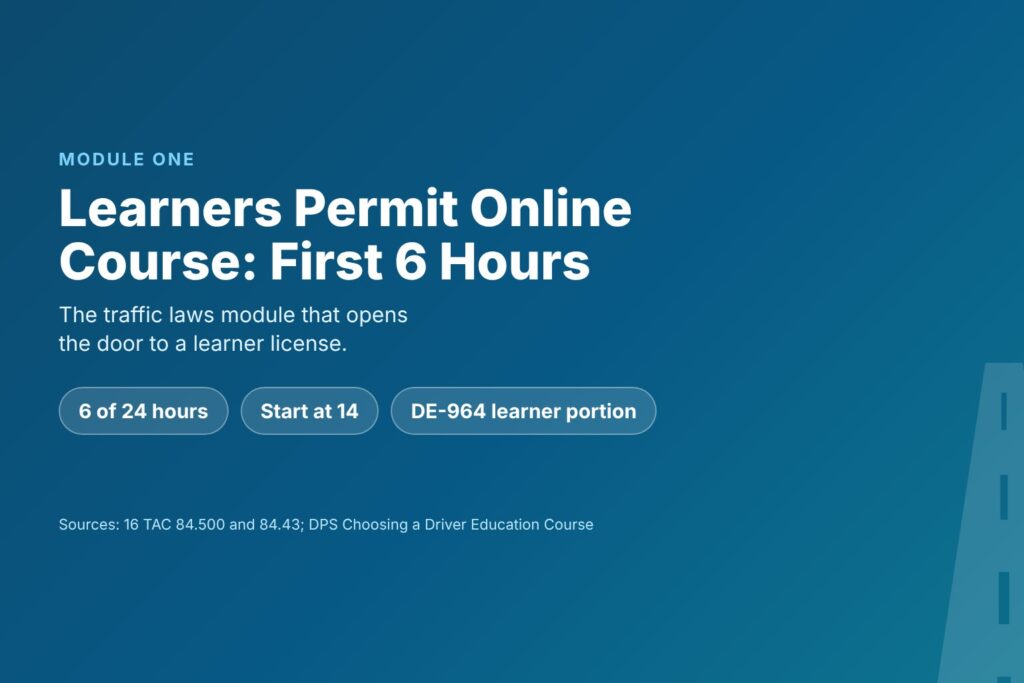
Title card reading Learners Permit Online Course Texas, Module One and the first six classroom hours

Texas Learner’s Permit Online Course: What the First 6 Hours Cover

Updated October 2026 · Reviewed by Billy Forte The learners permit online course Texas teens start with is Module One, the first six hours of the 24-hour classroom phase, titled “Traffic Laws.” On the concurrent method, a teen who finishes it gets the learner license portion of the DE-964 and can apply for a learner license at 15. The other 18 classroom hours come later, while the teen practices driving. Key Facts What Module One Is Texas sets the classroom minimum for minors at 24 hours. That rule is in 16 TAC 84.500, last amended effective December 1, 2024. The

Texas Learner’s Permit Online Course: What the First 6 Hours Cover Read More »

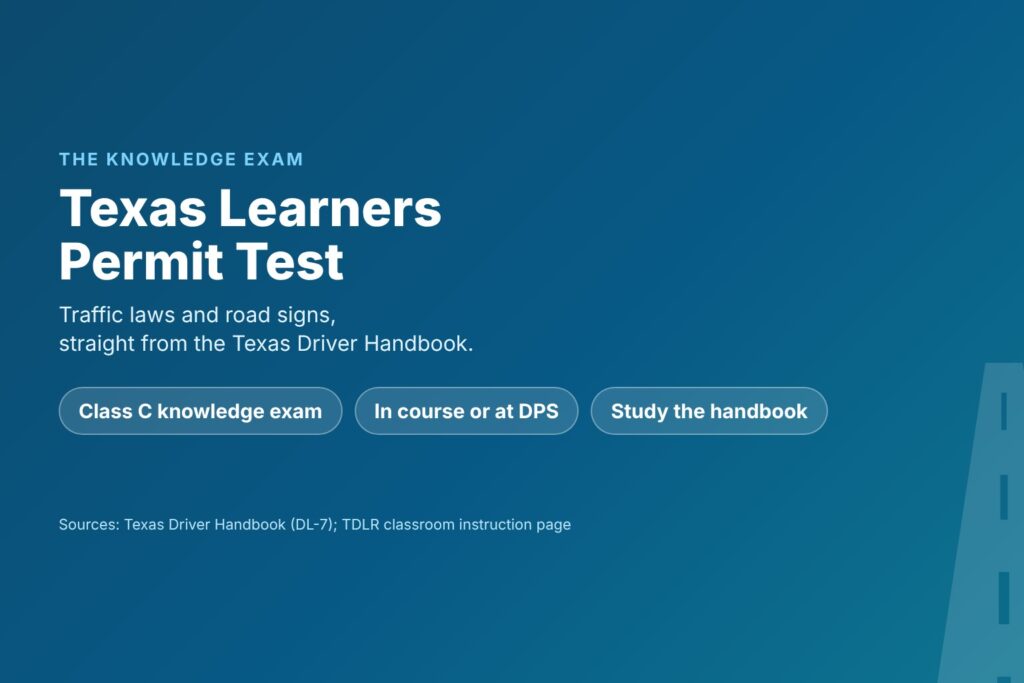
Title card reading Texas Learners Permit Test, traffic laws and road signs from the Texas Driver Handbook

Texas Learner’s Permit Knowledge Test: What’s on It and How to Prepare

Updated October 2026 · Reviewed by Billy Forte The texas learners permit test is the knowledge exam a teen passes before getting a learner license, and it covers Texas traffic laws and road signs from the Texas Driver Handbook. The course provider may give it during the classroom portion; if not, the teen takes it at a DPS driver license office. The handbook is the official study source, so build your preparation around it. Key Facts What the Test Is DPS calls it a knowledge exam. Its page Choosing a Driver Education Course calls it the learner’s permit written exam.

Texas Learner’s Permit Knowledge Test: What’s on It and How to Prepare Read More »

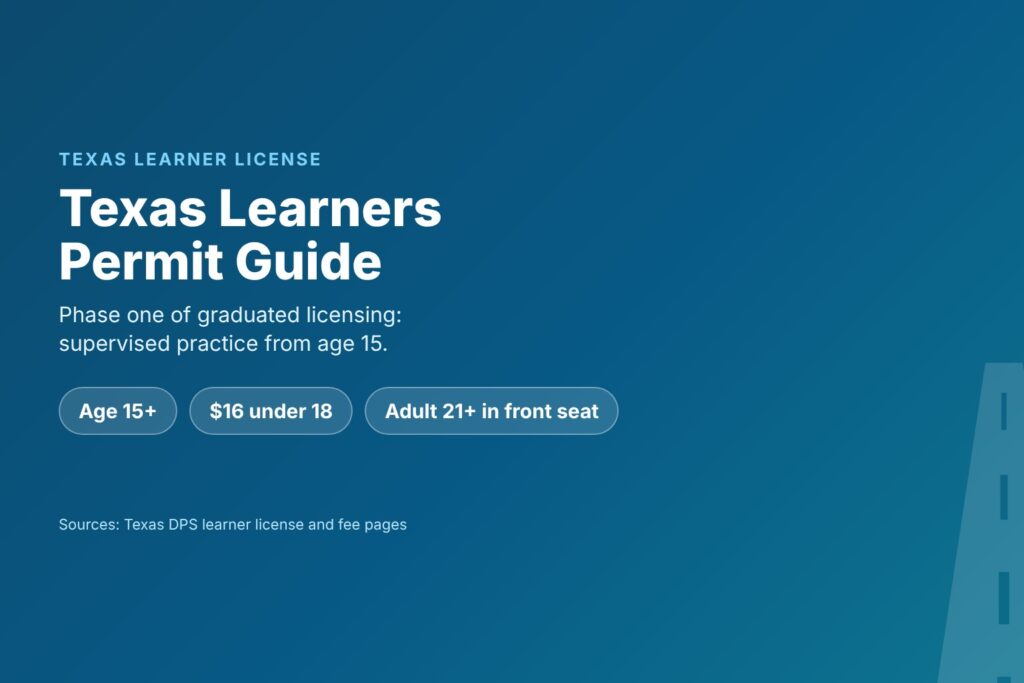
Title card reading Texas Learners Permit, with age 15, a 16 dollar fee and an adult 21 or older in the front seat

Texas Learner’s Permit: How to Get It, What You Need, and What It Allows

Updated October 2026 · Reviewed by Billy Forte A texas learners permit, which DPS calls a learner license, lets a teen 15 or older practice driving with a licensed adult 21 or older in the front passenger seat. To get one, the teen finishes the first part of a driver education course, passes a vision exam and a knowledge exam, and pays $16 at a DPS driver license office. The permit must be held at least six months before a provisional license, and it expires on the 18th birthday. Key Facts What a Texas Learners Permit Is Texas uses the

Texas Learner’s Permit: How to Get It, What You Need, and What It Allows Read More »

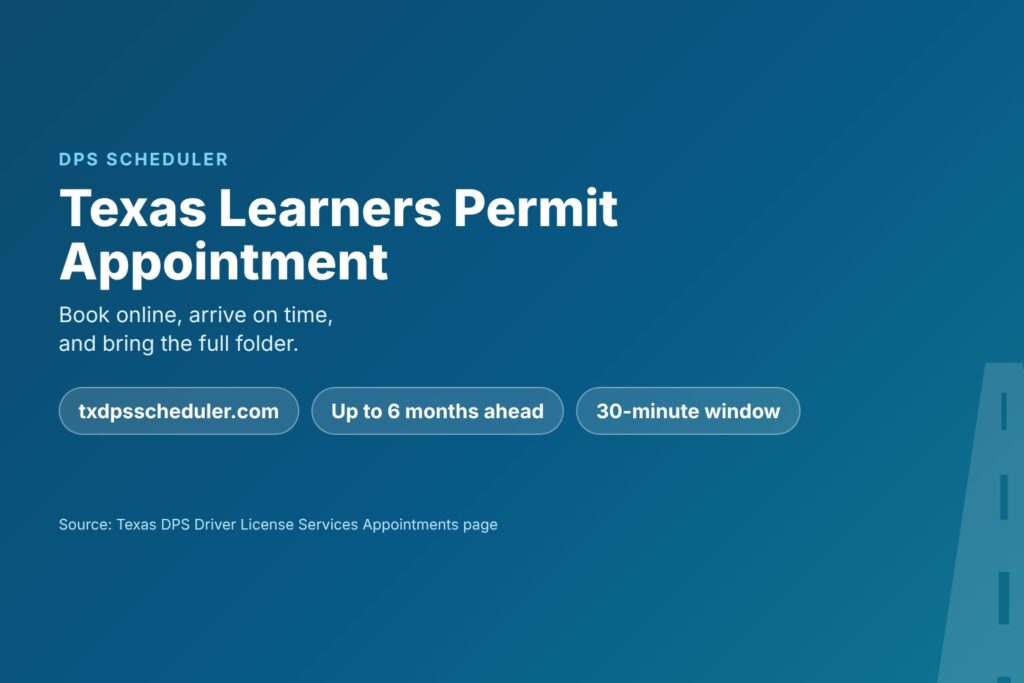
Title card reading Texas Learners Permit Appointment, book online up to six months ahead

How to Book a Texas DPS Appointment for Your Learner’s Permit

Updated October 2026 · Reviewed by Billy Forte You book a texas learners permit appointment online at txdpsscheduler.com, the DPS scheduler, up to six months ahead. Arrive no earlier than 30 minutes before the slot, because DPS cancels an appointment once you are more than 30 minutes late. If nothing fits, the self-service kiosk at a driver license office can book a same-day opening when one is free. Key Facts Why the Visit Needs an Appointment The DPS appointments page is direct on this point. It says, “All services are by scheduled appointment only.” That covers in-office driver license and

How to Book a Texas DPS Appointment for Your Learner’s Permit Read More »