
Updated October 2026 · Reviewed by Billy Forte
The Delaware defensive driving insurance discount works like this: if you choose to finish a DMV-approved course, you earn a 10% discount on part of your auto insurance premium for 3 years. That part is your bodily injury liability, property damage liability and personal injury protection (PIP) premiums. A Refresher taken on time raises the discount to 15%.
Key Facts
- The amount: 10% on the bodily injury, property damage and PIP premiums, for 3 years. See how it works.
- The 15% step: a Refresher in the 180 days before the 3 years end earns 15% at the next renewal. See 10% vs 15%.
- Proration: the full 10% applies only if every operator named on the policy finished a course. See proration.
- Proof: your course certificate is conclusive proof, so insurers may not ask for other documents. See proof for your insurer.
- Not eligible: a course ordered by a court or required by the DMV. See courses that do not qualify.
How the Delaware Defensive Driving Insurance Discount Works
Two rules set the discount, and both apply statewide. State law, 18 Del. C. 2503(a)(6), requires “a reduction in rates for a 3-year period” for a driver who voluntarily finishes an approved course. Regulation 607 then sets the percent.
Section 4.1 of Regulation 607 says, “A 10% discount shall be applied with respect to the applicable premium(s).” The course must be approved by the Delaware DMV, which has approved courses since March 11, 2015.
Insurers do not get to opt out. The DMV defensive driving FAQ says, “According to 18 DE Reg 607, insurance companies are required to offer a discount.” The Department of Insurance oversees the discount.
The Department of Insurance page puts it in plain words. A driver who finishes an approved course is “eligible to receive up to a 10 percent discount” “off a portion of his/her auto insurance for three years.”
Which Coverages the Discount Applies To
The discount does not apply to your whole premium. Section 3.0 of Regulation 607 lists the coverages it applies to:
- Bodily injury liability coverage.
- Property damage liability coverage.
- Personal injury protection (PIP) coverage.
Those three are the only coverages Regulation 607 lists. That is why the correct way to describe it is 10% on part of your premium. For any other part of your policy, ask your insurer.
10% vs 15%: The Two Discount Levels
Regulation 607 sets two discount levels. The first course earns 10%, and a Refresher on time earns 15%. A late Refresher can also bring 15%, but from a different start date.
| Discount | What triggers it | When it starts | What ends it |
|---|---|---|---|
| 10% | Voluntary completion of a DMV-approved course | Policy start or the first renewal after you apply | The renewal after 3 years from course completion |
| 15% on time | A Refresher in the 180 days before the 3 years end | The next renewal date | Not stated in Regulation 607; ask your insurer |
| 15% late | A Refresher within 2 years after the discount expired | The Refresher completion date | Not stated in Regulation 607; ask your insurer |
Both levels apply to the same three coverages. Regulation 607 4.1 prorates the 10% when not every named operator finished a course.
Who Qualifies
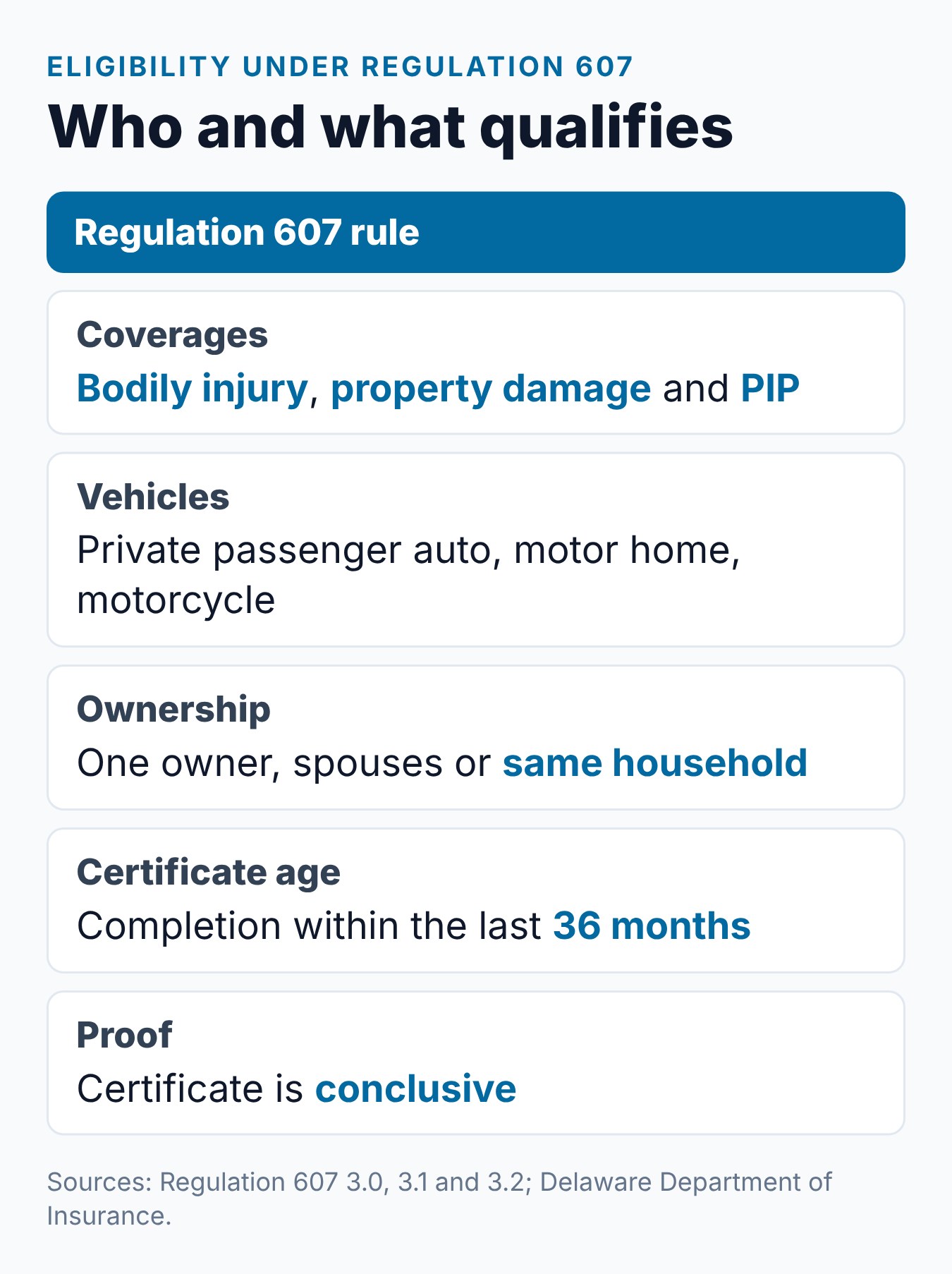
Regulation 607, sections 3.1 and 3.2, sets who qualifies. Three things must line up.
- The vehicle. It must be a private passenger auto, a motor home or a motorcycle.
- The owner. The vehicle is “individually owned or jointly owned by husband and wife or by members of the same household.”
- The certificate. The driver needs “a certificate certifying voluntary attendance and successful completion within the last 36 months.”
State law adds one more group. Under 18 Del. C. 2503(a)(6)b, certified instructors get the same reduction.
How Proration Works
The full 10% applies only when every operator named on the policy as an insured finished the course. Section 4.1 says the discount applies “if all operators named on the policy as insureds complete the course.”
If only some of them finished, the 10% is prorated by the share who did. State law says the same thing in 2503(a)(6)c.
Here is simple math with that rule. Say two operators are named on a policy and one finished a course. The share is one half, so the discount is prorated to half of the full 10%.
When the Discount Starts and Ends
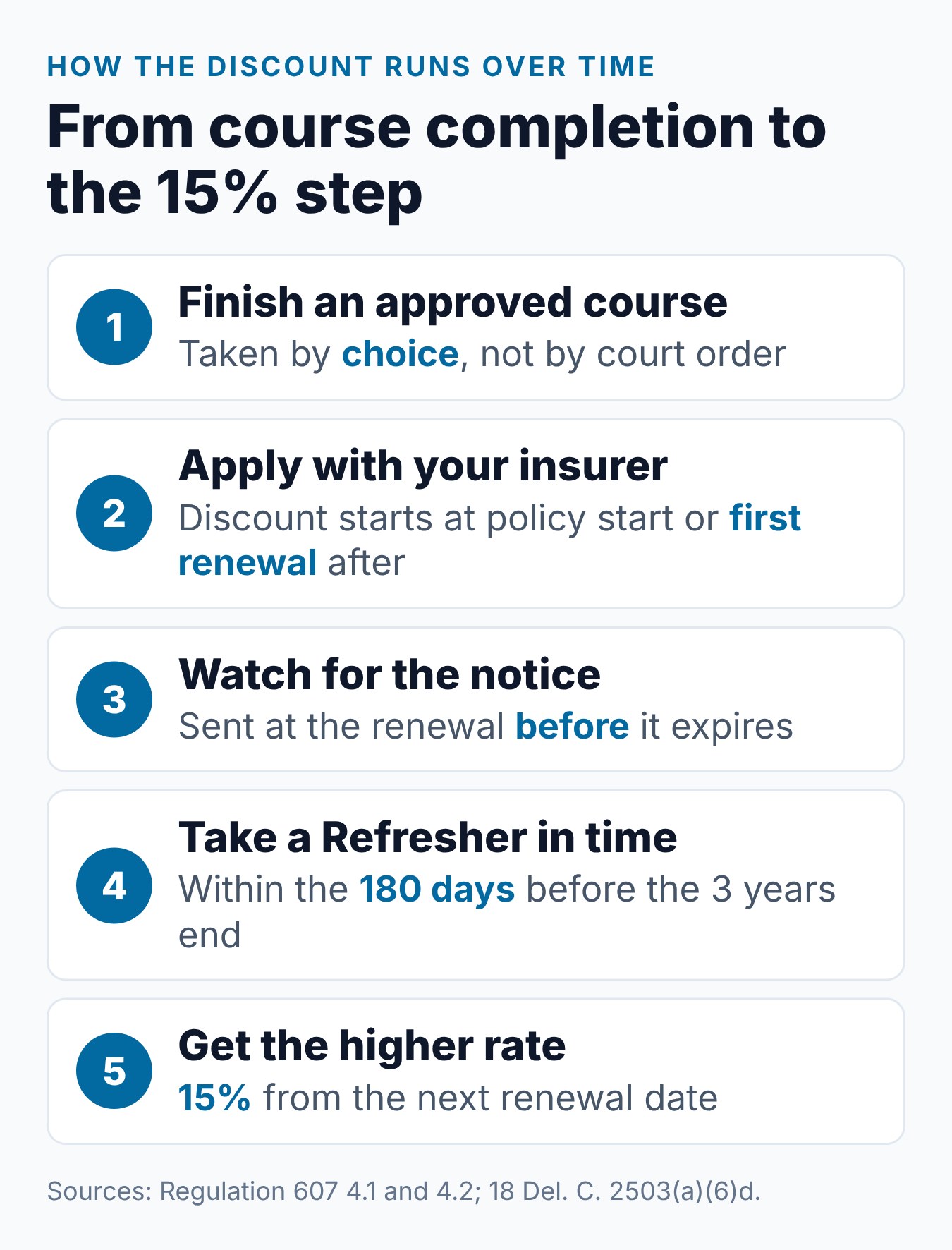
The discount does not start the day you finish. Under section 4.1, it begins “at the inception date of the policy or the first renewal date following application.” So you need to apply to your insurer.
It ends “at the policy renewal date subsequent to the expiration of three years since completion of the course.” In plain words, it runs out at the first renewal after the 3-year mark.
Your insurer must warn you first. Section 4.1 requires a notice at the renewal before the discount expires, saying a Refresher is needed.
Keeping the Discount With a Refresher
Section 4.2 of Regulation 607 sets the Refresher rules. Timing decides which result you get.
- On time. A Refresher “within the one hundred and eighty days prior to the three year expiration date” earns “a 15% discount effective the next renewal date.”
- Late. The driver “shall lose the 10% or 15% discount on the expiration date.”
- Within 2 years. A Refresher finished “within two years of the expiration date” brings “the 15% discount effective on the date of completion of the refresher course.”
The Refresher itself has a DMV window too. The DMV FAQ says it can be taken from 2 years and 6 months to 5 years after the first course. Our Refresher versus Basic guide explains both courses.
A Timing Example
Here is simple math with the official values. Say your 3-year mark falls on a given date. The on-time window opens 180 days before that date, and the late window closes 2 years after it.
A Refresher inside the first window brings 15% at the next renewal. A Refresher inside the second brings 15% from its completion date.
Courses That Do Not Qualify
The discount is for a course you chose to take. State law excludes two kinds of attendance.
- Court-ordered. A course ordered “as permitted by a court” does not qualify.
- DMV-required. A course the DMV requires for a Title 21 violation does not qualify either.
Both exclusions come from 18 Del. C. 2503(a)(6)d. Motorcycle rider courses approved by the DMV have their own rule in 2503(a)(7).
The Discount and the 3-Point Credit Are Separate
The same course can bring two benefits, but they follow different rules. The insurance discount comes from Regulation 607, and the Department of Insurance oversees it. The 3-point credit comes from Regulation 2208, and the DMV enters it on your record.
The credit does not decrease your point totals. The DMV says it “does not decrease your overall point values.” Our Delaware defensive driving course guide explains both benefits side by side.
Online Courses Count the Same
An approved online course counts the same as an approved classroom course for the discount. The rule turns on DMV approval and voluntary completion, not on the format. See our guide to the Delaware defensive driving course online for the exam and identity rules.
Proof for Your Insurer
Your course certificate is the proof. Under section 3.2 of Regulation 607, the certificate is conclusive proof of completion. Insurers may not require other documents.
The provider gives a free certificate to students with a valid Delaware driver license or ID card (Regulation 2224, section 4.4.5). If you lose it, the DMV FAQ says to contact the provider, and “there may be a cost.”
The certificate also shows your completion date. That date starts the 3-year clock for the discount and for the Refresher window. Our certificate guide explains reporting and lost copies.
If You Have a Problem With the Discount
The Department of Insurance handles complaints about the discount. Its page lists three ways to reach it:
- Email: consumer@delaware.gov
- Phone in Delaware: (800) 282-8611
- Phone: (302) 674-7310
What We Found on the Official Pages
On the official pages we checked on October 28, 2026, the discount rules matched across three sources. Regulation 607 sets 10% and 15%, and the Department of Insurance page says “up to” each amount. The DMV defensive driving page points to the same 3-year benefit.
The statute has two versions on the Delaware Code page. One is in effect until January 1, 2027, and one takes effect that day.
The course text in 2503(a)(6) is the same in both. Regulation 607 itself has been in effect since March 11, 2015.
Common Mistakes
These mistakes come from misreading the official rules:
- Calling it a discount on the whole premium. It applies to three listed coverages.
- Expecting it to start right away. It starts at the policy start or the first renewal after you apply.
- Forgetting other named operators. If not all of them finished, the 10% is prorated.
- Using a court-ordered course. Court-ordered and DMV-required courses do not qualify.
- Missing the 180-day window. An on-time Refresher earns 15% at the next renewal.
- Ignoring the renewal notice. It tells you a Refresher is needed before the discount expires.
- Using an old certificate. Regulation 607 looks for completion within the last 36 months.
How Requirements Can Vary
Delaware’s point system, defensive driving course rules and insurance discount come from state law and state regulations (Regulations 2208, 2224 and 607, and section 2503 of Title 18 of the Delaware Code) and apply statewide. How your ticket is handled is up to the court on your ticket. The fines in the Delaware Code do not include court costs and assessments, so the amount due is on your ticket.
Laws, regulations and DMV fees can change. Check your ticket, any DMV letter, the Delaware DMV website and the Delaware Code before you take a course or pay a ticket.
Frequently Asked Questions
How much is the Delaware defensive driving discount?
Regulation 607 sets 10% on the bodily injury, property damage and PIP premiums for 3 years. The 10% is prorated when not every named operator finished. A Refresher taken on time brings 15%.
Do insurers have to give the discount?
Yes. The DMV FAQ says, “insurance companies are required to offer a discount” under Regulation 607. The course must be approved by the DMV and taken by choice.
How long does the discount last?
It lasts until the policy renewal after 3 years from your course completion. Your insurer must send a notice at the renewal before it expires. A Refresher can bring 15% under the Regulation 607 timing rules.
Does a court-ordered course count?
No. State law excludes a course ordered by a court. It also excludes a course the DMV requires for a Title 21 violation.
What proof does my insurer need?
Your course certificate. Regulation 607 makes it conclusive proof, and insurers may not ask for other documents. The certificate must show completion within the last 36 months.
Does an online course qualify?
Yes, if the DMV approved it and you took it by choice. The format does not change the discount. Check the DMV “Online Courses” list before you start.
Who do I contact if my insurer will not apply it?
Contact the Delaware Department of Insurance at consumer@delaware.gov. You can also call (800) 282-8611 in Delaware or (302) 674-7310.
Does the discount cover my whole policy?
No. Regulation 607 lists three coverages: bodily injury liability, property damage liability and PIP. For any other part of your policy, ask your insurer.
Conclusion
The discount is 10% on the bodily injury, property damage and PIP premiums for 3 years, and 15% after an on-time Refresher. If you need a course now, choose one from the DMV’s approved list so your certificate counts. The Delaware defensive driving course at Driving Logic is coming soon.
Related Articles
- Delaware Defensive Driving Course: Basic and Refresher Guide
- Delaware Defensive Driving Refresher Course vs. Basic Course
- Delaware Defensive Driving Course Online: How It Works
- Delaware Defensive Driving Certificate: Reporting and Proof
Sources
- 18 DE Admin Code 607 — Motor Vehicle Accident Prevention Course Discount (PDF)
- Delaware Department of Insurance — Defensive Driving Discount
- Delaware DMV — Defensive Driving Courses
- Delaware DMV — Defensive Driving FAQ (PDF)
Billy Forte is the owner of Driving Logic, an online driver education course provider serving drivers in several U.S. states.
This article is general information, not legal advice. Delaware course rules, point values, fines and penalties depend on your ticket, court, DMV notice and case facts, and they can change. Use official Delaware DMV, Delaware Code and court sources, and consult a qualified Delaware attorney for advice about your own case.