
Updated October 2026 · Reviewed by Billy Forte
If you searched delaware traffic court, the short answer is that the Justice of the Peace (JP) Court “hears certain misdemeanors and most motor vehicle cases (excluding felonies),” and going to court means a trial you must attend. The Court of Common Pleas hears some motor vehicle offenses, such as speed exhibitions, and appeals from the JP Court. The court decides the case, but the Delaware Division of Motor Vehicles (DMV) assesses any points.
Key Facts
- Main court: the JP Court hears “most motor vehicle cases (excluding felonies).” See which court hears your case.
- Requesting a trial: sign the ticket and mail or fax it by the court date, then appear. See contesting a ticket.
- Probation before judgment (PBJ): no conviction and no points, but not for CDL holders charged with a motor vehicle offense or a person granted PBJ for an offense under the same title within five years of the current offense. See PBJ.
- Appeals from the JP Court: to the Court of Common Pleas within 15 days of the conviction, only if the fine is over $100 or jail was imposed. See appeals.
- Points: the court does not assess points; the DMV does. See points after court.
Which Delaware Traffic Court Hears Your Case
Traffic cases in Delaware go to a few courts with set roles.
Start with the JP Court. The Delaware Courts overview says the JP Court “hears certain misdemeanors and most motor vehicle cases (excluding felonies).” Even so, your ticket names the court for your own case.
The Court of Common Pleas has a second role. Its jurisdiction page lists “Motor Vehicle Offenses” and “Appeals of Criminal Matters from the Justice of the Peace Courts.”
Some tickets come from a town’s Alderman’s Court. The JP Court Traffic FAQ says those tickets are paid to that court. The court name is printed on the ticket.
Courts at a Glance
This table shows what each court does in a traffic case, based on official court pages.
| Court | Role in a traffic case | Official source |
|---|---|---|
| Justice of the Peace Court | Hears most motor vehicle cases (excluding felonies) | Delaware Courts overview |
| Court of Common Pleas | Hears appeals from the JP Court | JP Court Traffic FAQ |
| Court of Common Pleas | Original jurisdiction over speed exhibitions | HB 277 (84 Del. Laws c. 484) |
| Alderman’s Court | Its own tickets are paid to that court | JP Court Traffic FAQ |
The Court of Common Pleas and Speed Exhibitions
Speed exhibition cases skip the JP Court. House Bill 277 gave the Court of Common Pleas original jurisdiction over these cases in 2024.
The law is 84 Del. Laws c. 484, and the offense is section 4172 of Title 21.
Speed exhibitions also cannot be paid by mail. Under 21 Del. C. 709(e), they are left out of the Voluntary Assessment Center (VAC) process.
Reckless driving is on that list too. Our guide to reckless driving in Delaware covers that charge.
How to Contest a Ticket and Request a Trial
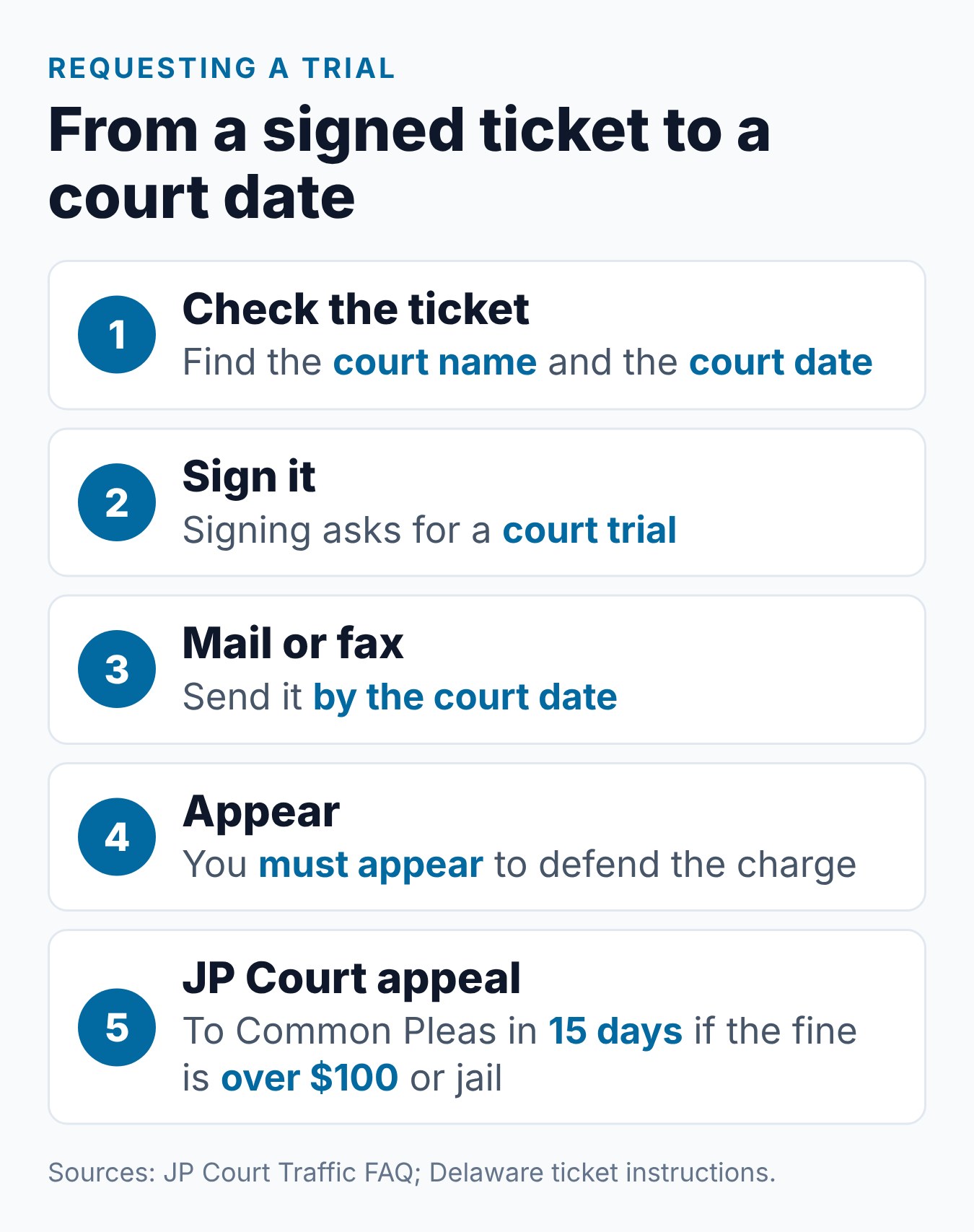
To contest a ticket, you request a trial. The JP Court Traffic FAQ explains the steps:
- Sign the ticket to show you want a trial
- Mail or fax it by the court date
- Appear in court on the date set
The FAQ is direct about what this means. It says “you are requesting a court trial and must appear in court to defend the charge(s).”
So contesting is not a mail-in process. Once you request a trial, you go to court. Whether to request one is your choice, and a Delaware attorney can answer questions about your own case.
Mandatory-Appearance Tickets
Some tickets require you to appear in court. You cannot handle them by mail.
The state’s ticket instructions warn about missing that date. If you do not appear, “your driving privileges may be suspended and a warrant for your arrest may be issued without further notice.”
The ticket shows which kind it is. A mandatory-appearance ticket is handled in court, not through the mail.
Probation Before Judgment
Probation before judgment (PBJ) is a court outcome under 11 Del. C. 4218. The JP Court Traffic FAQ says that under PBJ, “there is no conviction and no points are assessed.”
PBJ is not open to everyone. Among the eligibility limits in section 4218, PBJ is not available to:
- CDL holders charged with an offense involving a motor vehicle
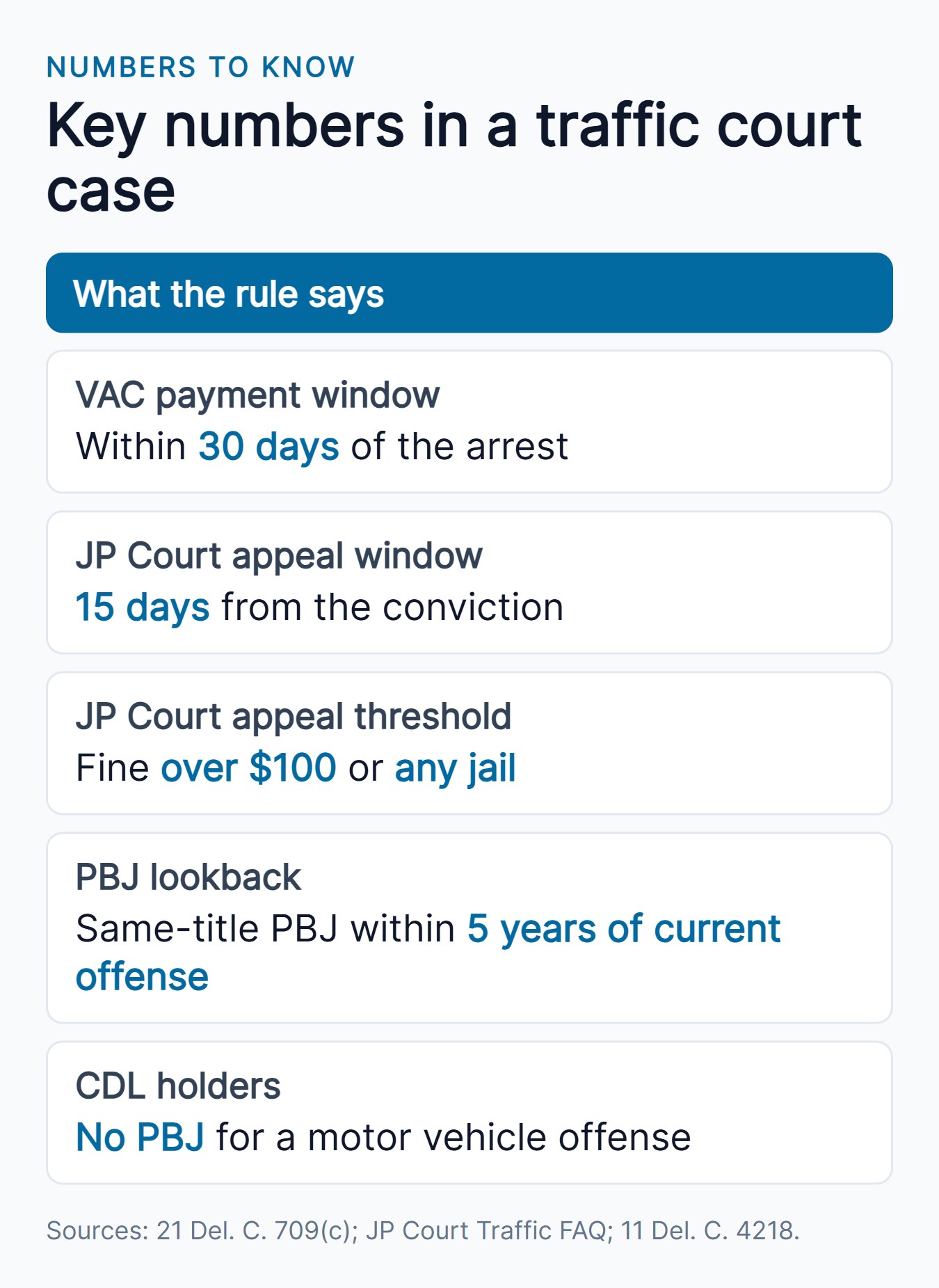
- Anyone who received PBJ for an offense under the same title within five years of the current offense
The ticket instructions add a wider condition: “No motor vehicle convictions or PBJ within the previous five (5) years and cannot hold a CDL.” Requesting PBJ also requires a court appearance. This article states the rules only; it does not say whether PBJ fits your case.
CDL Holders in Traffic Court
Commercial drivers face stricter rules. Under 11 Del. C. 4218, PBJ is not available to a CDL holder charged with a motor vehicle offense.
Federal law adds a second limit. Under 49 CFR 384.226, a state “must not mask, defer imposition of judgment, or allow an individual to enter into a diversion program” that would keep a CDL holder’s conviction off the record.
One point rule also does not help CDL holders. The DMV gives no points for a first ticket of 1-14 mph over in 3 years paid through the VAC or by mail, but only for Class D license holders. The DMV says “CDL holders will receive points.”
Appeals to the Court of Common Pleas
An appeal from the JP Court goes to the Court of Common Pleas. The JP Court Traffic FAQ sets two limits:
- Timing: the appeal must be filed within 15 days of the conviction
- Threshold: only if the fine is over $100 or any jail term was imposed
So not every JP Court traffic case can be appealed. A case with a fine of $100 or less and no jail does not meet the threshold.
The 15-day limit is short. For questions about a specific appeal, contact the court or a Delaware attorney.
Paying Instead of Going to Court
The Voluntary Assessment Center (VAC) lets a driver pay a ticket without going to court. Under 21 Del. C. 709(i), payment “is an admission of guilt, a waiver of the right to a hearing, and a complete satisfaction of the violation.”
The VAC must receive payment within 30 days of the arrest. Our guide to the Voluntary Assessment Center explains what paying means. To find a ticket and the ways to pay, see our Delaware traffic ticket lookup guide.
An unpaid ticket has its own results. The DMV refuses to renew a Delaware resident’s license. For a nonresident, Delaware driving privileges may be suspended.
Drivers From Other States
Section 709(d) says who may use the VAC process. It covers Delaware residents and residents of reciprocal states. It also covers other out-of-state residents who, “in the discretion of the arresting peace officer, are deemed to be reliable prospects.”
If a nonresident does not pay, the DMV “may suspend the driving privileges in this State” under section 709(j). The ticket instructions add, “Delaware DMV will notify your Division of Motor Vehicles if you fail to pay by the due date.”
Points After Court
The court decides guilt, but it does not set points. The JP Court Traffic FAQ says, “The Court does not assess points.”
The DMV assesses points under Regulation 2208. A conviction, whether by trial or by paying, can add points to your record. PBJ is different, since there is no conviction and no points.
Once points post, the DMV counts them at full value for 12 months from the violation date. They count at half value for the next 12 months. The DMV acts only on convictions within the 24-month period after the offense date.
Our Delaware point system guide explains point values and DMV actions. For speeding fines and options, see our pillar guide on the Delaware speeding ticket.
What We Found on the Official Court Pages
On the official court pages we checked on October 28, 2026, three details stood out.
First, the Delaware Courts overview uses the word “most” for the JP Court’s share of motor vehicle cases. It does not say all. Second, the Court of Common Pleas page lists both “Motor Vehicle Offenses” and appeals from the JP Court.
Third, the JP Court Traffic FAQ says in one line that the court does not assess points. The same FAQ cites “DMV Policy #45” for the rule that a first minor speeding ticket paid by mail gets no points.
Common Mistakes
Each item below is checked against a Delaware law, rule or official court page:
- Thinking paying is neutral. Paying through the VAC is an admission of guilt under 21 Del. C. 709(i).
- Mailing a signed ticket and staying home. A trial request means you “must appear in court.”
- Skipping a mandatory appearance. Driving privileges may be suspended and a warrant may be issued.
- Expecting PBJ with a CDL. Section 4218 bars PBJ for CDL holders charged with a motor vehicle offense.
- Assuming every JP Court case can be appealed. The fine must be over $100 or jail must be imposed.
- Missing the appeal window. A JP Court appeal must be filed within 15 days of the conviction.
- Thinking the court sets points. The DMV assesses points, not the court.
How Requirements Can Vary
Delaware’s point system, defensive driving course rules and insurance discount come from state law and state regulations (Regulations 2208, 2224 and 607, and section 2503 of Title 18 of the Delaware Code) and apply statewide. How your ticket is handled is up to the court on your ticket. The fines in the Delaware Code do not include court costs and assessments, so the amount due is on your ticket.
Laws, regulations and DMV fees can change. Check your ticket, any DMV letter, the Delaware DMV website and the Delaware Code before you take a course or pay a ticket.
Frequently Asked Questions
What court handles traffic tickets in Delaware?
The Justice of the Peace Court “hears certain misdemeanors and most motor vehicle cases (excluding felonies).” The Court of Common Pleas hears some motor vehicle offenses, such as speed exhibitions. It also hears appeals from the JP Court.
How do I request a trial for a Delaware traffic ticket?
Sign the ticket and mail or fax it by the court date. The JP Court Traffic FAQ says you “must appear in court to defend the charge(s).”
What is probation before judgment in Delaware?
PBJ is a court outcome where “there is no conviction and no points are assessed.” It is not available to CDL holders charged with a motor vehicle offense. It is also not available to anyone with PBJ under the same title within five years of the current offense.
Can I appeal a JP Court traffic decision?
Yes, in some cases. The appeal goes to the Court of Common Pleas within 15 days of the conviction. It is allowed only if the fine is over $100 or any jail term was imposed.
Does the court put points on my license?
The court does not. The JP Court Traffic FAQ says, “The Court does not assess points.” The DMV assesses points under Regulation 2208 after a conviction.
What happens if I miss a mandatory court date?
The ticket instructions say your driving privileges may be suspended. They also say a warrant for your arrest may be issued without further notice.
Is paying a ticket the same as going to court?
They are different. Paying through the VAC is an admission of guilt and a waiver of the right to a hearing. Going to court means a trial that you must attend.
Conclusion
Delaware traffic cases go mainly to the JP Court, while the Court of Common Pleas hears appeals and speed exhibitions. For your own case, read your ticket and contact the court on it or a Delaware attorney.
For drivers who want to learn about the voluntary course, the Delaware defensive driving course at Driving Logic is coming soon. Drivers who need a course now should choose one from the DMV’s approved list.
Related Articles
- Delaware Speeding Ticket: Fines, Points and Your Options
- Voluntary Assessment Center Delaware: What Paying Means
- Delaware Traffic Ticket Lookup: How to Find and Pay a Ticket
- Delaware Point System: How Driving Points Work
The PBJ limits summarized here are not exhaustive. Prior convictions and the charge can also affect eligibility; the court decides whether PBJ is available under section 4218.
Sources
- Delaware Justice of the Peace Court — Traffic FAQs
- Delaware Courts — Overview of the Court System
- Delaware Court of Common Pleas — Jurisdiction
- Delaware Ticket Instructions (DELJIS, PDF)
- 49 CFR § 384.226 — Prohibition on masking convictions
Billy Forte is the owner of Driving Logic, an online driver education course provider serving drivers in several U.S. states.
This article is general information, not legal advice. Delaware course rules, point values, fines and penalties depend on your ticket, court, DMV notice and case facts, and they can change. Use official Delaware DMV, Delaware Code and court sources, and consult a qualified Delaware attorney for advice about your own case.